
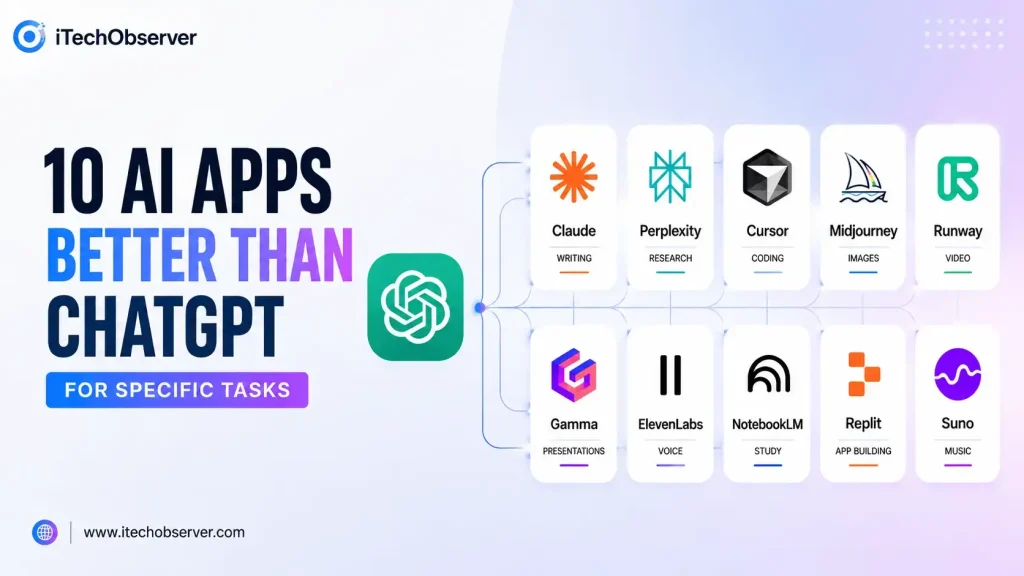
10 AI Apps Better Than ChatGPT for Specific Tasks (2026)
Artificial intelligence has moved far beyond the era of asking a chatbot to write an email or summarize a paragraph.
In 2026, the most useful AI tools are increasingly specialized. Instead of trying to do everything inside one conversational interface, newer AI applications are being designed around specific workflows: researching the web, writing and analyzing long documents, coding entire applications, generating images, producing videos, creating presentations, generating realistic voices, studying personal materials, and even making music.
That shift matters because ChatGPT is not necessarily the best AI tool for every task.
ChatGPT remains one of the most capable general-purpose AI assistants available. It can write, code, research, analyze files, create images, brainstorm ideas, and handle a wide range of everyday tasks. But a specialized application can often provide a better workflow because its entire interface, model, and feature set are built around one particular job.
For example, a developer may prefer an AI-native code editor over copying code into a chatbot. A researcher may want a search engine that automatically provides citations. A student studying a collection of PDFs may benefit more from an AI notebook grounded in those exact sources.
That is where this list comes in.
We’ve selected 10 AI apps that can outperform ChatGPT for specific use cases in 2026. These aren’t necessarily replacements for ChatGPT. In many cases, the smartest approach is to use them alongside a general-purpose AI assistant.
Important: “Better than ChatGPT” in this article means better suited to a particular task or workflow—not necessarily more intelligent overall.
Quick Comparison: 10 AI Apps That Beat ChatGPT at Specific Tasks
| AI App | Best For | Why It Can Be Better Than ChatGPT |
|---|---|---|
| Claude | Long-form writing & document work | Exceptional long-context handling and professional writing |
| Perplexity | Web research | Search-first workflow with citations and source links |
| Cursor | Software development | AI integrated directly into the coding environment |
| Midjourney | AI image creation | Highly focused image generation and visual style control |
| Runway | AI video | Generation and detailed AI-powered video editing in one workflow |
| Gamma | Presentations | Turns prompts and documents into designed presentations |
| ElevenLabs | Voice & audio | Specialized speech, voice cloning, dubbing and audio generation |
| NotebookLM | Research & studying | Answers grounded in your own sources |
| Replit Agent | Building apps | Turns natural-language instructions into working applications |
| Suno | Music generation | Built specifically for generating and customizing music |
What Makes a Specialized AI App Better Than ChatGPT?
Before looking at the individual tools, it is important to understand what “better” actually means.
A general AI assistant is designed to handle many different tasks. That flexibility is its greatest advantage—but it can also be a limitation.
A specialized AI app can optimize almost every part of the experience around one workflow.
For example:
- A coding application can understand your repository.
- A research platform can search and cite web sources.
- An image generator can focus entirely on visual composition.
- A presentation tool can automatically structure slides.
- A music platform can generate songs rather than simply discuss music.
- A research notebook can keep answers tied to your uploaded sources.
In other words, the advantage is often workflow specialization rather than simply model intelligence.
This distinction is important when comparing AI tools in 2026.
1. Claude — Best for Long-Form Writing and Document Analysis
Claude is one of the strongest alternatives to ChatGPT when your work involves long documents, sophisticated writing, analysis, or complex professional tasks.
Anthropic’s current Claude lineup has continued to expand its capabilities for coding, agents, computer use, and professional work. Claude Sonnet 4.6, for example, features a 1-million-token context window in API beta, while Anthropic’s current Opus lineup is positioned for demanding coding, agentic and professional workloads.
Why Claude Can Be Better Than ChatGPT
Claude is particularly impressive when the task requires maintaining context across a large amount of information.
Instead of giving an AI a small section of a document at a time, you can work with large collections of material and ask Claude to analyze relationships between different sections.
That makes it useful for:
- Long-form articles
- Books and manuscripts
- Business reports
- Contracts and documents
- Research papers
- Technical documentation
- Content editing
- Strategic analysis
Anthropic also positions its latest Claude models for long-running agents, coding, browser/computer use, financial analysis, research, and professional document work.
Claude vs. ChatGPT for Writing
ChatGPT is arguably more versatile because it combines writing with a broad range of other capabilities.
Claude’s advantage is its document-centric workflow and long-context strength.
If you’re writing a 10-page report, reviewing a lengthy proposal, restructuring a large document, or trying to maintain a consistent tone across a huge piece of content, Claude can be an excellent choice.
Best Claude Use Cases
Best for: Writers, researchers, consultants, students, analysts and professionals working with lengthy documents.
Our verdict: If your primary AI workload is serious writing and document analysis, Claude deserves to be one of the first tools you test.
2. Perplexity — Best for Web Research
Perplexity takes a fundamentally different approach from a traditional chatbot.
It is designed as an AI-powered search engine, combining conversational answers with web search and source citations.
Perplexity says its answers are backed by verifiable sources and that responses include citations and links to original material. Its platform also offers different research modes, including Search and Deep Research capabilities.
Why Perplexity Can Be Better Than ChatGPT
Imagine you want to research:
“What are the best cloud storage services for small businesses in 2026?”
You don’t just want an answer. You want:
- Current information
- Multiple sources
- Recent developments
- Evidence
- Links to original pages
That’s where Perplexity becomes particularly useful.
Instead of treating the web as something you manually browse after receiving an answer, Perplexity makes web research the center of its workflow.
Key Features
- Real-time web search
- Inline citations
- Source links
- Follow-up research
- Deep research workflows
- Multiple AI model options
- Research-focused interface
Best Uses for Perplexity
Perplexity is particularly useful for:
- SEO research
- Journalism
- Market research
- Product comparisons
- Academic research
- Competitive research
- Current events
- Fact checking
Perplexity vs. ChatGPT
ChatGPT can also perform web research, so the difference is not simply “one searches the web and the other doesn’t.”
The bigger difference is workflow design.
Perplexity feels like an AI-native research engine. ChatGPT feels more like a general-purpose assistant that can also research.
For researchers who frequently need sources, Perplexity can therefore be the more efficient choice.
Our verdict: If your work starts with “search the internet and find the evidence,” Perplexity deserves a place in your toolkit.
3. Cursor — Best AI Tool for Coding
Cursor is aimed directly at software developers.
Rather than asking an AI chatbot to generate a code snippet and then manually transferring that code into your development environment, Cursor integrates AI directly into the coding workflow.
That difference is enormous.
Why Cursor Can Be Better Than ChatGPT for Developers
When working on a real application, developers aren’t simply asking:
“Write a Python function.”
They are dealing with:
- Multiple files
- Dependencies
- Existing architecture
- APIs
- Tests
- Configuration
- Bugs
- Git repositories
- Frameworks
- Deployment environments
Cursor is built around that reality.
Its background agents can work asynchronously in remote environments, edit and run code, install packages, and provide updates while developers retain the ability to take over or provide follow-up instructions.
What Cursor Can Help With
- Code generation
- Debugging
- Refactoring
- Repository analysis
- Feature development
- Code explanation
- Testing
- Documentation
- Agent-based development
Why an AI Code Editor Matters
A general chatbot can generate excellent code, but the developer still has to move between the chatbot and their development environment.
Cursor reduces that friction.
The AI is operating where the code actually lives.
Best For
- Professional developers
- Software startups
- Web developers
- App developers
- Students learning programming
- Indie hackers
Our verdict: For serious software development, an AI-native coding environment can be considerably more useful than a standalone chatbot.
4. Midjourney — Best for AI Image Generation
Midjourney remains one of the most recognizable names in AI image generation.
While general-purpose AI assistants can now generate images, Midjourney is built around visual creation from the ground up.
Its current development has continued to focus heavily on aesthetics, image quality, and personalization. Midjourney’s V8.2 release in July 2026 specifically emphasized stronger aesthetics, creativity, image quality and personalization.
Why Midjourney Can Be Better Than ChatGPT for Images
The difference is specialization.
If you need a chatbot to create a quick visual alongside a written answer, ChatGPT may be more convenient.
But if your primary goal is creating:
- Concept art
- Editorial imagery
- Advertising visuals
- Character designs
- Fantasy artwork
- Product concepts
- Cinematic scenes
- Creative compositions
Midjourney is worth considering.
Where Midjourney Stands Out
Midjourney’s emphasis on visual aesthetics makes it particularly attractive to designers and creative professionals who care about:
- Composition
- Lighting
- Style
- Detail
- Visual consistency
- Artistic direction
Its V8.1 update also emphasized improved prompt adherence, coherence, text rendering, speed and personalization.
Midjourney vs. ChatGPT
ChatGPT is better when you want an AI assistant that can think through the creative brief, write the prompt, explain the design and generate supporting content.
Midjourney is more specialized when the central objective is the image itself.
Our verdict: For serious AI artwork and visual experimentation, Midjourney remains one of the strongest specialist tools.
5. Runway — Best for AI Video Creation
Runway is one of the most powerful options for creators who want to generate and edit video using AI.
Runway’s current platform goes beyond simple text-to-video generation. It combines video generation, AI editing, image-to-video, video-to-video workflows, object manipulation and other creative tools.
Why Runway Can Be Better Than ChatGPT
ChatGPT can help you develop a video concept, write a script, create prompts and plan a production.
But Runway is designed to actually work with the visual production process.
You can start with:
- Text
- An image
- Existing video footage
Then refine the result using AI.
Runway supports tasks such as changing backgrounds, removing objects, altering lighting, restyling footage and extending videos.
What Makes Runway Interesting in 2026?
Runway has increasingly positioned itself as a broader creative platform rather than simply an AI video generator.
Its current platform brings together multiple image, video, audio and language models, while tools such as Aleph 2.0 are designed for AI-powered video editing.
Best For
- YouTubers
- Filmmakers
- Advertising agencies
- Social media creators
- Marketing teams
- Video editors
- Creative studios
Our verdict: If your primary output is video rather than text, Runway is a much more natural AI environment than a general chatbot.
6. Gamma — Best for AI Presentations
Gamma addresses one of the most frustrating productivity tasks: turning information into a professional presentation.
Instead of starting with a blank PowerPoint slide, Gamma allows you to provide a prompt, outline, document or other source material and generate a structured presentation.
Gamma says its AI can create a working presentation in under a minute, then let users refine, present, share or export it.
Why Gamma Can Be Better Than ChatGPT
ChatGPT can write the content for a presentation.
But writing the content is only part of the job.
You still have to:
- Create slides.
- Decide what goes on each slide.
- Choose layouts.
- Add images.
- Format text.
- Maintain visual consistency.
- Export the finished presentation.
Gamma automates much more of that workflow.
What Gamma Can Do
- Generate complete presentations
- Convert text into slides
- Import documents
- Apply themes
- Generate layouts
- Add visual elements
- Rewrite slide content
- Export to common formats
- Publish presentations online
Gamma also supports PowerPoint, PDF, PNG and Google Slides workflows, making it easier to move generated content into traditional presentation environments.
Best For
- Business presentations
- Pitch decks
- Sales proposals
- Training material
- Education
- Marketing presentations
- Internal company reports
Our verdict: If you’re staring at a blank presentation and thinking, “I wish AI could just build this,” Gamma is one of the tools worth trying first.
7. ElevenLabs — Best for AI Voice and Audio
ElevenLabs started with highly realistic AI speech and has expanded into a much broader audio and creative platform.
Its current products include text-to-speech, voice cloning, speech-to-text, dubbing, music and conversational voice agents. ElevenLabs says its voice generation platform supports 70+ languages and offers a large voice library alongside voice cloning and voice design capabilities.
Why ElevenLabs Can Be Better Than ChatGPT
A chatbot can write your script.
ElevenLabs can turn that script into a polished voice performance.
That distinction makes it particularly useful for content creators.
Popular Uses
- YouTube narration
- Podcasts
- Audiobooks
- E-learning
- Advertising
- Character voices
- Video narration
- Multilingual dubbing
- Voice agents
ElevenLabs has also expanded into music and broader creative production. Its 2026 updates include Music v2 and Dubbing v2, alongside newer tools for voice agents and creative workflows.
Voice Cloning
Voice cloning is one of the platform’s most recognizable capabilities.
Creators can build customized voices for projects instead of relying exclusively on standard synthetic voices.
However, voice cloning should always be used responsibly and with appropriate authorization when a real person’s voice is involved.
Our verdict: For professional AI voiceovers, narration and audio production, ElevenLabs is far more specialized than a general-purpose chatbot.
8. NotebookLM — Best AI Research and Study Assistant
NotebookLM is one of the most interesting AI applications for people who need to work with their own information.
Instead of primarily asking:
“What does the AI know?”
NotebookLM encourages you to ask:
“What can the AI understand from these sources?”
You can upload or connect materials such as PDFs, websites, YouTube videos, audio files, Google Docs and Google Slides. NotebookLM then provides answers grounded in those sources with inline citations.
Why NotebookLM Can Be Better Than ChatGPT
Imagine you’re studying a 300-page textbook.
You don’t necessarily want an AI to give you a general answer based on everything it knows about the subject.
You want it to answer:
“What does my textbook say about this?”
That’s NotebookLM’s strength.
Useful Features
NotebookLM can turn source material into:
- Study guides
- Briefing documents
- Mind maps
- Audio Overviews
- Video Overviews
- Reports
- Flashcards
- Quizzes
- Infographics
- Slide decks
Google’s current documentation shows that NotebookLM can create multiple types of source-grounded artifacts directly from notebooks.
Its Audio Overview feature is particularly interesting because AI hosts can discuss the key points from uploaded sources in a conversational format.
Best For
- Students
- Researchers
- Teachers
- Professionals
- Consultants
- Writers
- Anyone working with large collections of documents
NotebookLM vs. ChatGPT
ChatGPT is the better choice when you want a broad AI assistant.
NotebookLM becomes particularly compelling when your own source material is the center of the task.
Our verdict: For studying, document-grounded research and turning personal source material into useful learning resources, NotebookLM is difficult to ignore.
9. Replit Agent — Best for Building Apps With Natural Language
Replit is pushing AI-assisted software development toward a much more accessible model.
Instead of starting with a programming language and manually writing every component, Replit Agent lets you describe the application you want and then works toward building it.
Replit describes Agent as a system that can take an app or website idea and build it through natural-language interaction, including web research when necessary and advanced options for more complex work.
Why Replit Agent Can Be Better Than ChatGPT
ChatGPT can generate:
- HTML
- CSS
- JavaScript
- Python
- React
- APIs
- Database code
But generating code isn’t the same as creating a working application.
Replit focuses on the build-and-deploy workflow.
What Replit Agent Can Help With
- Websites
- Web applications
- Prototypes
- Databases
- Application logic
- Debugging
- Deployment
- Iterative development
This makes it particularly attractive to entrepreneurs who have an idea but don’t necessarily have years of programming experience.
Example
You could describe something like:
“Build a simple project-management dashboard where users can create projects, assign tasks and track progress.”
Instead of receiving a block of code and figuring out what to do next, Replit Agent is designed to turn the request into an actual project that can be refined through additional instructions.
Best For
- Entrepreneurs
- Indie hackers
- Developers
- Students
- Startup teams
- Rapid prototyping
Our verdict: If your goal is to go from an idea to a functioning application quickly, Replit Agent can provide a more complete workflow than a traditional chatbot.
10. Suno — Best AI Music Generator
Suno is one of the clearest examples of why specialized AI applications are becoming so powerful.
Instead of simply helping you write lyrics or discuss music, Suno is designed around music creation itself.
Suno’s v5.5 model introduced features including Voices, Custom Models and My Taste, with the company describing improvements in vocals, arrangements and personalization.
Why Suno Can Be Better Than ChatGPT
ChatGPT can help you write:
- Lyrics
- Song concepts
- Chord ideas
- Music prompts
- Marketing copy
But Suno can turn the idea into an actual song.
That’s a completely different level of specialization.
What Suno Can Create
Depending on the workflow, users can create:
- Full songs
- Instrumentals
- Background music
- Social media tracks
- Demos
- Genre experiments
- Vocal performances
Suno’s newer tools also allow users to work with their own voice and create personalized music experiences.
The platform has continued adding editing capabilities as well, including improved stem separation tools in 2026.
Best For
- Musicians
- Content creators
- Video creators
- Songwriters
- Hobbyists
- Advertising teams
- Social media creators
Our verdict: For actually generating music rather than simply talking about it, Suno is one of the most compelling specialist AI tools available.
ChatGPT vs. Specialized AI Apps: Which Approach Is Better?
The answer isn’t necessarily to abandon ChatGPT.
In fact, doing so may be counterproductive.
The better strategy for many people is to use multiple AI tools according to the task.
Think of ChatGPT as a general-purpose AI operating layer.
Then use specialized tools when a particular task demands a deeper workflow.
| Task | Recommended AI |
|---|---|
| General brainstorming | ChatGPT |
| Long documents | Claude |
| Web research | Perplexity |
| Coding | Cursor |
| AI artwork | Midjourney |
| Video generation | Runway |
| Presentations | Gamma |
| Voiceovers | ElevenLabs |
| Source-based research | NotebookLM |
| App development | Replit Agent |
| Music | Suno |
This approach gives you the best of both worlds.
Which AI App Is the Best ChatGPT Alternative?
There isn’t one universal winner.
The best alternative depends entirely on what you’re trying to accomplish.
Best ChatGPT Alternative for Writers
Claude
Choose Claude if you regularly work with long documents, complex writing projects or detailed analysis.
Best for Researchers
Perplexity
Choose Perplexity when finding current information and verifying sources is more important than having a general conversation.
Best for Developers
Cursor
Choose Cursor if you spend most of your day inside a codebase.
Best for Images
Midjourney
Choose Midjourney when visual quality and artistic experimentation are your main priorities.
Best for Video
Runway
Choose Runway if you’re producing AI-generated or AI-edited video.
Best for Presentations
Gamma
Choose Gamma when you want to turn an idea or document into a polished presentation quickly.
Best for Voice
ElevenLabs
Choose ElevenLabs for realistic narration, voice generation, dubbing and audio workflows.
Best for Studying
NotebookLM
Choose NotebookLM when you want an AI assistant that stays closely connected to your own source material.
Best for Building Apps
Replit Agent
Choose Replit Agent when your goal is turning a natural-language idea into a working application.
Best for Music
Suno
Choose Suno when the desired output is an actual song rather than text about music.
Are These AI Apps Actually Better Than ChatGPT?
This is where the comparison needs some nuance.
Saying that one AI is simply “better” than another is usually misleading.
A tool can be better at one task while being worse at another.
For example:
ChatGPT may be better for:
General-purpose assistance, brainstorming, writing, coding, analysis and combining multiple types of tasks.
Perplexity may be better for:
Research-first workflows where citations and current web information are central.
Cursor may be better for:
Developers working directly inside large software projects.
Midjourney may be better for:
Specialized image generation and artistic experimentation.
NotebookLM may be better for:
Questions that need to stay grounded in a specific collection of sources.
Runway may be better for:
Generating and editing video.
This is why the future of AI isn’t necessarily about finding one AI that replaces every other AI.
It’s increasingly about finding the right AI for each workflow.
How to Build an AI Workflow Around These Apps
You don’t need to subscribe to every AI service on this list.
Instead, start with the tasks that consume the most time in your workflow.
For example, a content creator might use:
ChatGPT → Brainstorm topics and develop a content strategy
Perplexity → Research current facts and sources
Claude → Develop and edit long-form content
Midjourney → Create visual concepts
Runway → Turn concepts into short videos
ElevenLabs → Generate narration
A software entrepreneur could use:
ChatGPT → Product brainstorming
Perplexity → Market research
Cursor → Development
Replit Agent → Rapid prototyping
Claude → Documentation and technical analysis
A student could use:
Perplexity → Discover research material
NotebookLM → Analyze course documents
Claude → Improve writing
ChatGPT → Brainstorm and explain difficult concepts
The key is not to collect as many AI subscriptions as possible.
The key is to match the tool to the job.
What to Consider Before Choosing an AI App
Before paying for another AI service, consider five things.
1. Does It Solve a Specific Problem?
Don’t use an AI tool simply because it is popular.
Ask whether it eliminates a genuine bottleneck in your workflow.
2. Does It Save Time?
A specialized AI application should make a task significantly faster or easier.
If you still have to perform most of the work manually, the benefit may be limited.
3. How Accurate Is It?
AI-generated content can contain errors.
This is especially important for:
- Research
- Finance
- Legal work
- Healthcare
- Business decisions
- Technical documentation
Always verify important information.
4. How Does It Handle Your Data?
Before uploading confidential documents, source code, business information or personal data, review the service’s privacy and data-use policies.
Convenience should not come at the expense of security.
5. Can It Integrate With Your Existing Workflow?
The best AI tool isn’t necessarily the one with the most features.
It is often the one that fits naturally into the tools you already use.
The Biggest AI Trend in 2026: Specialization
One of the most important developments in AI is the move from general-purpose chatbots toward specialized AI systems.
Early AI adoption largely revolved around a simple interface:
Type a question → receive an answer.
The next phase is more workflow-oriented:
Give the system a goal → let it use the appropriate tools → review the result.
That’s why products such as Cursor, Replit Agent, NotebookLM and Runway are so interesting.
They aren’t simply trying to create another chatbot.
They’re building AI around a specific job.
That shift could eventually matter more than which company has the largest language model.
Final Verdict: Don’t Look for One AI to Do Everything
The biggest lesson from the current AI landscape is simple:
The best AI isn’t always the smartest AI. It’s the AI that fits the task.
ChatGPT remains an exceptionally capable general-purpose assistant, but specialization is becoming one of the biggest advantages in the AI market.
Claude can be a better choice for lengthy documents and sophisticated writing. Perplexity can make web research faster and easier to verify. Cursor brings AI directly into software development. Midjourney focuses on image creation, while Runway tackles video production.
Gamma reduces the work involved in building presentations. ElevenLabs specializes in voice and audio. NotebookLM turns your own documents into an interactive research assistant. Replit Agent helps turn ideas into applications, and Suno transforms prompts into music.
The result is not necessarily a world without ChatGPT.
Instead, we’re moving toward a world where ChatGPT is one tool in a much larger AI toolbox.
For everyday questions, brainstorming and general productivity, a versatile AI assistant may still be all you need.
But when the task becomes highly specialized, using the right purpose-built AI can save time, improve the workflow and sometimes produce a dramatically better result.
That’s the real advantage of the AI ecosystem in 2026: you no longer have to force one AI to do everything.
Frequently Asked Questions
What is the best AI app better than ChatGPT?
There is no single AI app that is better than ChatGPT at everything. Claude is particularly strong for long-form writing, Perplexity for web research, Cursor for coding, Midjourney for images, Runway for video and NotebookLM for source-grounded research.
Which AI is better than ChatGPT for research?
Perplexity is one of the strongest options for web research because its workflow is built around searching the internet and providing citations and links to sources.
NotebookLM is a better choice when your research is primarily based on documents and sources you provide yourself.
Which AI is better than ChatGPT for coding?
Cursor is an excellent choice for software development because it integrates AI directly into the coding environment and supports agentic workflows, including background agents that can edit and run code remotely.
Is Claude better than ChatGPT?
Claude can be better for certain workloads, particularly long-form writing, document analysis, coding and complex professional tasks. However, ChatGPT offers a broader all-purpose ecosystem, so the better option depends on your workflow.
Is Perplexity better than ChatGPT?
Perplexity can be better when your priority is web research, current information and source citations. ChatGPT can be more useful when you want to combine research with writing, reasoning, coding and other tasks.
What is the best AI image generator in 2026?
Midjourney remains a strong choice for AI image creation, particularly for artistic and highly visual work. Its V8.2 update in July 2026 focused on aesthetics, image quality and personalization.
What is the best AI video generator in 2026?
Runway is one of the leading options for AI video generation and editing. Its current platform supports text-to-video, image-to-video, video editing and multiple generative models.
Which AI is best for presentations?
Gamma is one of the strongest choices for AI-generated presentations because it can transform prompts, documents and outlines into designed presentations that can then be edited, presented or exported.
What is the best AI voice generator?
ElevenLabs is a leading choice for AI voice generation, offering text-to-speech, voice cloning, dubbing and other audio capabilities across numerous languages.
Is NotebookLM better than ChatGPT for studying?
For studying from a specific set of materials, NotebookLM can be a better fit because its responses are grounded in your notebook sources and can include citations. It can also create study guides, quizzes, flashcards, audio overviews and other learning materials.
Can Replit Agent build an app without coding?
Replit positions Agent as a natural-language application builder that can create apps and websites through conversational instructions, making it accessible to people with limited coding experience.
Is Suno better than ChatGPT for music?
For music generation specifically, Suno is far more specialized. Its current platform is built around creating songs and music, with features such as custom models, personalized music experiences and voice capabilities.
Do I need all 10 AI apps?
No. Most users only need two or three.
Start with the tools that solve your biggest productivity problems. A writer might need Claude and Perplexity, while a developer may benefit more from Cursor and Replit Agent.
Quick Picks
Best for long-form writing: Claude
Best for research: Perplexity
Best for coding: Cursor
Best for images: Midjourney
Best for video: Runway
Best for presentations: Gamma
Best for voice: ElevenLabs
Best for studying: NotebookLM
Best for app development: Replit Agent
Best for music: Suno
Best all-purpose AI assistant: ChatGPT


Hey there 👋 I’m Awais, the curious mind behind iTech Observer.
I’m a tech blogger who loves diving deep into AI and Cybersecurity, but my real passion is making those topics easy to understand — especially for small business owners trying to grow in a digital world.
Here on iTech Observer, I break down the latest tech trends, tools, and security tips into practical, real-world advice you can actually use. Whether you’re trying to secure your business website, understand how AI can boost productivity, or just want to stay updated on what’s next in tech — you’re in the right place.
I believe technology should empower, not overwhelm.
Let’s explore the innovations that can make your business stronger, smarter, and more secure.
Discussion
Comments are closed.