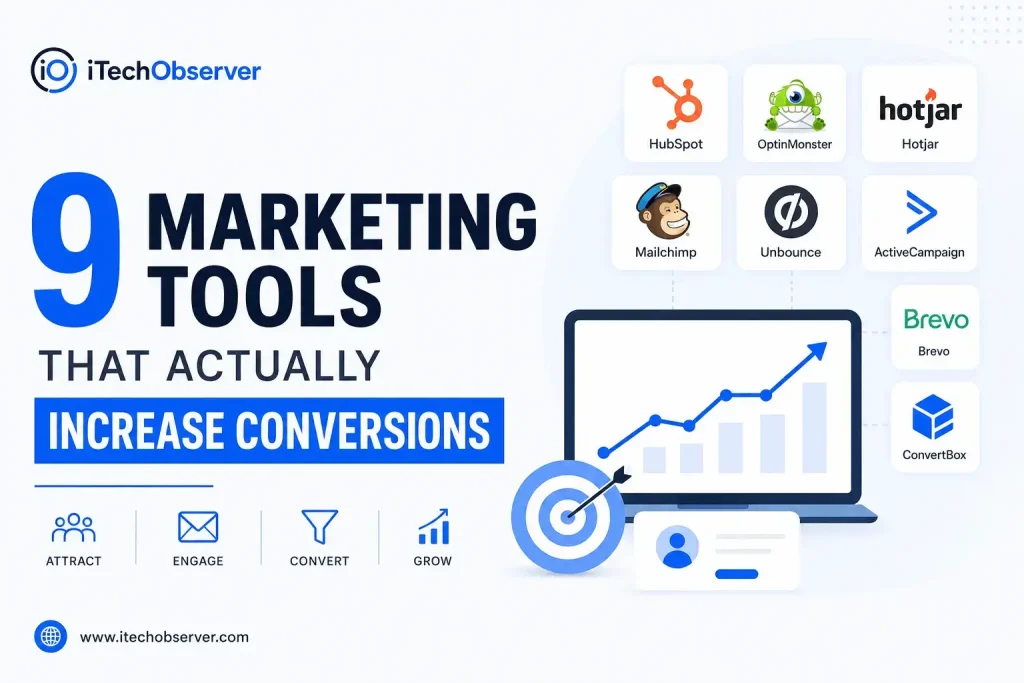
9 Marketing Tools That Actually Increase Conversions
Getting people to visit your website is great, but traffic alone doesn’t pay the bills. What really matters is what those visitors do once they arrive — whether they sign up, request a quote, start a trial, or make a purchase.
That’s where the right marketing tools can make a real difference.
Today’s marketing platforms can do much more than send emails or display basic analytics. They can show you how visitors interact with your site, identify where potential customers are dropping off, automate follow-ups, personalize offers, and help you turn more of your existing traffic into actual customers.
In this guide, we’ll look at 9 marketing tools that can help increase conversions, what each one does best, and which types of businesses can get the most from them.
Why Marketing Tools Matter
Even a beautifully designed website can struggle to convert if you don’t understand what your visitors need.
The right tools can help you answer important questions:
- Where are visitors dropping off?
- Which pages generate the most leads?
- Why are people abandoning their carts?
- Which emails actually get opened and clicked?
- Which offers work best for different audiences?
- Which parts of your website are creating friction?
Instead of relying on guesswork, you can use real customer behavior to make smarter decisions.
Marketing tools can help you:
- Understand visitor behavior
- Automate repetitive tasks
- Personalize customer experiences
- Capture more leads
- Recover abandoned carts
- Improve landing pages
- Build better email campaigns
- Keep existing customers engaged
The key, however, isn’t simply buying more software. It’s choosing tools that solve specific problems in your marketing funnel.
1. HubSpot Marketing Hub
Best For: All-in-one marketing
If you want to manage a large part of your marketing operation from one place, HubSpot Marketing Hub is one of the strongest options to consider.
It brings several important marketing functions together, including CRM, email marketing, landing pages, lead capture, automation, analytics, and live chat.
That means your marketing and customer data can work together instead of being scattered across different platforms.
Key Features
- AI-assisted email writing
- Automated workflows
- Lead scoring
- Smart CTAs
- Personalized emails
- CRM integration
- Landing page builder
Why It Can Increase Conversions
One of HubSpot’s biggest advantages is personalization.
Instead of showing every visitor exactly the same message, businesses can tailor their marketing based on factors such as customer behavior, engagement, previous interactions, and other available data.
That can make the customer journey feel much more relevant.
Pros
- Strong automation capabilities
- Built-in CRM
- Comprehensive analytics
- Lots of marketing features in one platform
Cons
- Costs can increase as your business and requirements grow
Pricing: A free option is available, while paid plans start around $20/month, with more advanced tiers costing considerably more.
2. OptinMonster
Best For: Lead generation
Getting visitors to your site is one thing. Getting them to give you their email address or take another meaningful action is another.
OptinMonster is designed specifically around that challenge.
It lets you create targeted campaigns that appear at strategic moments, including when a visitor is about to leave your website.
Popular Campaign Types
- Exit-intent popups
- Floating bars
- Spin-to-win campaigns
- Fullscreen campaigns
- Slide-ins
- Coupon offers
Key Features
- Exit-intent technology
- Geo-targeting
- Device targeting
- Page-level targeting
- A/B testing
- Campaign analytics
Why It Can Increase Conversions
Timing matters.
A generic popup shown to everyone can quickly become annoying. A targeted offer shown to the right visitor at the right moment can be much more useful.
For example, you might show a first-time visitor a free guide while offering a returning customer a discount or product recommendation.
3. Hotjar
Best For: Understanding visitor behavior
Analytics can tell you what happened. Tools like Hotjar can help you understand why it happened.
Hotjar gives marketers a closer look at how people actually use their websites through features such as heatmaps, session recordings, surveys, and feedback tools.
Features
- Heatmaps
- Session recordings
- Surveys
- User feedback
- Conversion funnels
Why It Can Improve Conversions
Imagine seeing visitors repeatedly move their cursor toward a button that doesn’t work, struggle to find a form, or abandon a page halfway through.
Those are problems that traditional traffic numbers may not make obvious.
Hotjar can help uncover issues such as:
- Confusing navigation
- Weak or hidden CTAs
- Poor mobile layouts
- Broken interactions
- Difficult-to-use forms
Once you know where users are struggling, you have a much better chance of fixing the problem.
4. Mailchimp
Best For: Email marketing
Not every visitor will buy something on their first visit.
That’s why email marketing remains important. It gives businesses a way to stay connected with people who aren’t ready to convert immediately.
Mailchimp makes it relatively easy to create campaigns, manage subscribers, segment audiences, and automate follow-ups.
Key Features
- Email campaigns
- AI-assisted content suggestions
- Automation
- Customer segmentation
- Landing pages
- Signup forms
How It Helps With Conversions
A well-designed automated email sequence can continue nurturing a potential customer long after they’ve left your website.
Common examples include:
- Welcome emails
- Abandoned-cart reminders
- Product recommendations
- Re-engagement campaigns
- Promotional sequences
Instead of manually following up with every lead, you can build a system that does much of the work automatically.
5. Unbounce
Best For: Conversion-focused landing pages
Sending advertising or campaign traffic to your homepage isn’t always the best approach.
A visitor who clicks an ad for a specific product or offer should ideally land on a page that continues that same conversation.
That’s where Unbounce comes in.
It allows marketers to build dedicated landing pages designed around specific campaigns and conversion goals.
Features
- AI-powered landing page creation
- Smart Traffic
- Popups
- Sticky bars
- A/B testing
Why It Can Increase Conversions
A focused landing page removes distractions and keeps visitors centered on one goal.
Instead of asking visitors to navigate around your entire website, you can give them a clear message, a relevant offer, and a straightforward next step.
6. ActiveCampaign
Best For: Marketing automation
Some leads need more than one email before they’re ready to buy.
ActiveCampaign is designed for businesses that want to build more advanced customer journeys and automate those interactions.
It combines marketing automation with CRM, email, SMS, and customer journey features.
Key Features
- CRM
- Email marketing
- SMS
- Marketing automation
- Customer journeys
- Predictive sending
Examples of Automation
You can use automation to:
- Follow up after someone views a product
- Send abandoned-cart reminders
- Notify a sales team when a lead becomes highly engaged
- Recommend additional products
- Re-engage inactive customers
The biggest advantage is consistency. Prospects can receive relevant follow-ups without someone on your team having to remember every individual interaction.
7. Google Analytics 4 (GA4)
Best For: Measuring website performance
You can’t improve your conversion rate if you don’t know what’s happening on your website.
Google Analytics 4 gives marketers data about traffic sources, engagement, user journeys, purchases, and other important interactions.
GA4 Can Help You Track
- Traffic sources
- User journeys
- Purchases
- Button interactions
- Engagement
- Conversion activity
Why It Matters
Suppose thousands of people visit your landing page but very few complete your signup form.
That’s a signal worth investigating.
GA4 can help you identify where users are coming from and where they appear to leave. Pairing that information with a tool such as Hotjar can give you both the numbers and the behavioral context behind them.
8. Brevo
Best For: Small businesses
Smaller businesses don’t always need a huge collection of separate marketing platforms.
Brevo brings several useful features together, including email marketing, SMS, CRM, chat, WhatsApp campaigns, and automation.
Key Features
- Transactional email
- Marketing automation
- Contact segmentation
- CRM
- SMS campaigns
- Live chat
Why It’s Worth Considering
For a small team, keeping marketing simple can be just as important as having lots of features.
Brevo gives businesses a way to manage several communication channels without having to build an unnecessarily complicated technology stack.
9. ConvertBox
Best For: Personalized lead capture
Not every visitor should necessarily see the same message.
ConvertBox focuses on personalized lead capture, allowing businesses to show different offers based on visitor characteristics and behavior.
These can include:
- Referral source
- Returning visitor status
- Purchase history
- Scroll depth
- Time spent on a page
- Device type
Why Personalization Matters
Consider two visitors.
The first person is visiting your website for the first time. The second has already visited several times and knows your product.
Showing both people the exact same offer may not make sense.
Instead, you could offer the new visitor a free guide while presenting a returning visitor with a discount or an upgrade opportunity.
That kind of personalization can make marketing feel more relevant and less intrusive.
Marketing Tools Comparison
| Tool | Best For | Free Plan | AI Features | Conversion Focus |
|---|---|---|---|---|
| HubSpot | All-in-one marketing | Yes | Yes | Excellent |
| OptinMonster | Lead generation | No | Limited | Excellent |
| Hotjar | User behavior | Yes | Yes | High |
| Mailchimp | Email marketing | Yes | Yes | High |
| Unbounce | Landing pages | Trial | Yes | Excellent |
| ActiveCampaign | Automation | Trial | Yes | Excellent |
| Google Analytics 4 | Analytics | Yes | AI insights | High |
| Brevo | Small businesses | Yes | Yes | High |
| ConvertBox | Personalized popups | No | Limited | Excellent |
How to Choose the Right Marketing Tool
There isn’t one marketing platform that’s perfect for every business.
The right choice depends on where you’re currently struggling.
For Beginners
Start with:
- Mailchimp
- Brevo
- Google Analytics 4
These can cover basic email marketing and analytics without requiring an overly complicated setup.
For eCommerce
Consider:
- HubSpot
- OptinMonster
- ActiveCampaign
These tools can help with lead capture, customer follow-ups, automation, and abandoned-cart campaigns.
For SaaS Companies
Consider:
- HubSpot
- Unbounce
- Hotjar
Together, they can help with lead management, landing pages, and understanding user behavior.
For Bloggers
Consider:
- Mailchimp
- ConvertBox
- Hotjar
These are particularly useful for growing an email audience and understanding how readers interact with your content.
For Agencies
Consider:
- HubSpot
- ActiveCampaign
- Unbounce
These provide a broader set of tools for managing campaigns, leads, and conversion-focused pages.
The Marketing Tool Stack We’d Recommend
You don’t need every tool on this list.
In fact, using too many platforms can make your marketing harder to manage.
A practical setup could look something like this:
- Google Analytics 4 — Understand where your traffic comes from and what visitors do.
- Hotjar — See how visitors interact with important pages.
- HubSpot — Manage leads, CRM data, and automation.
- Mailchimp or Brevo — Build and automate email campaigns.
- OptinMonster — Capture visitors before they leave.
- Unbounce — Create focused landing pages for campaigns.
Together, these tools cover most of the conversion journey:
Measure → Understand → Capture → Nurture → Optimize → Convert
Tips to Increase Conversions Beyond Using Tools
Software can give you better data and automation, but it can’t fix a weak offer or confusing website on its own.
To get better results, focus on the fundamentals too:
- Write clear headlines that immediately explain the value.
- Give visitors a strong reason to take action.
- Use prominent, relevant calls-to-action.
- Keep forms as short as possible.
- Make sure your website works well on mobile devices.
- Improve slow-loading pages.
- Add genuine reviews and testimonials.
- Use trust signals where customers need reassurance.
- Test different headlines, layouts, and offers.
- Personalize campaigns when you have enough customer data.
- Review your analytics regularly and act on what you discover.
Small changes can sometimes make a bigger difference than adding another tool to your stack.
Final Thoughts
The goal isn’t to collect as many marketing tools as possible.
It’s to understand where your conversion funnel is losing potential customers and then choose software that helps solve that specific problem.
If you don’t know what’s happening, start with analytics. If visitors are leaving without taking action, look at their behavior and your landing pages. If you’re generating leads but struggling to turn them into customers, email marketing and automation may be the better place to focus.
You also don’t have to implement everything at once.
A simple setup such as GA4 → Hotjar → CRM → Email Automation → Conversion Optimization can be far more useful than a complicated collection of disconnected platforms.
At the end of the day, the best marketing tool isn’t necessarily the one with the longest feature list. It’s the one that solves a real problem in your funnel, gives you useful information, and helps you create a better experience for your customers.
Choose the problem first. Choose the tool second. Then measure the results and keep improving.
Frequently Asked Questions
Can marketing automation really improve conversion rates?
Yes. Marketing automation can help businesses follow up with leads, send relevant messages, and keep potential customers engaged without requiring someone to handle every interaction manually.
The biggest benefit comes when automation is based on customer behavior rather than sending the same message to everyone.
Which marketing tool is best for email marketing?
Mailchimp, Brevo, and ActiveCampaign are all strong options, but they serve slightly different needs.
Mailchimp is a good starting point for beginners, Brevo is appealing to smaller businesses looking for several communication channels, while ActiveCampaign is better suited to businesses that need more advanced automation.
Do I need a CRM to increase conversions?
Not necessarily.
You can improve conversions without a CRM, especially if you’re running a small operation. However, as your number of leads and customers grows, a CRM can make it much easier to keep track of conversations, follow-ups, and customer activity.
HubSpot is one example of a platform that combines CRM and marketing features.
What’s the difference between analytics and conversion optimization tools?
Analytics tools tell you what is happening.
For example, Google Analytics 4 can show where visitors come from and what actions they take.
Conversion optimization tools are more focused on helping you improve what happens next. Tools such as Hotjar, OptinMonster, and Unbounce can help identify friction points, test changes, and encourage visitors to take action.
Are AI-powered marketing tools worth using?
They can be, particularly when they save time or help personalize the customer experience.
AI features can assist with tasks such as content creation, campaign optimization, personalization, and automation. But AI shouldn’t replace good marketing strategy. A poorly targeted campaign won’t become effective simply because AI is involved.
Which marketing tool is best for eCommerce stores?
There isn’t one universal winner.
A combination of HubSpot, OptinMonster, ActiveCampaign, and Google Analytics 4 can cover several important areas, including lead capture, customer journeys, automation, and performance tracking.
Your choice should ultimately depend on the size of your store, your existing technology, and where customers are dropping out of the buying process.
Can marketing tools help reduce cart abandonment?
Yes.
Email and automation platforms can send reminders to customers who leave items in their carts. Depending on the platform and setup, businesses can also use SMS or personalized offers to encourage customers to return and complete their purchase.
How do I choose the right marketing tool for my business?
Start with the problem, not the software.
If you don’t understand your website traffic, start with analytics. If visitors aren’t engaging with your pages, consider behavior-tracking and conversion tools. If you’re struggling to follow up with leads, look at CRM and automation platforms.
Once you know what needs fixing, choosing the right tool becomes much easier.
Are marketing tools suitable for beginners?
Yes. Many popular platforms offer templates, guided setup, tutorials, and free plans.
For someone just starting out, tools such as Google Analytics 4, Mailchimp, and Brevo can provide a useful foundation without requiring a large marketing team.
Can I use these marketing tools together?
Yes.
Many marketing platforms offer native integrations, while services such as Zapier can connect tools that don’t have a direct integration.
The important thing is to keep your setup manageable. More tools don’t automatically mean better results. A smaller collection of well-connected tools is often easier to maintain and more useful than a complicated marketing stack.


Hey there 👋 I’m Awais, the curious mind behind iTech Observer.
I’m a tech blogger who loves diving deep into AI and Cybersecurity, but my real passion is making those topics easy to understand — especially for small business owners trying to grow in a digital world.
Here on iTech Observer, I break down the latest tech trends, tools, and security tips into practical, real-world advice you can actually use. Whether you’re trying to secure your business website, understand how AI can boost productivity, or just want to stay updated on what’s next in tech — you’re in the right place.
I believe technology should empower, not overwhelm.
Let’s explore the innovations that can make your business stronger, smarter, and more secure.